I love talking about wine with people who share my passion for it. We open bottles, we trade stories about travel and soil types, terroir and residual sugar, and we talk of taste and food and restaurants. We recommend wines to one another, we drink, and we learn a lot.
In Wine Talk, I introduce you to friends, acquaintances, and people I encounter as I make my way around the world, from Houston to Mexico City, Los Angeles to Burgundy, and other locales far and near, individuals who love and respect wine as much as I do, who live to taste, who farm and make wine. Whether my subject is a collector, a winemaker, a chef, a sommelier, a buyer, a grower, or simply an avid drinker of wine, you’ll appreciate their insight, and I hope you’ll learn something from them as well.
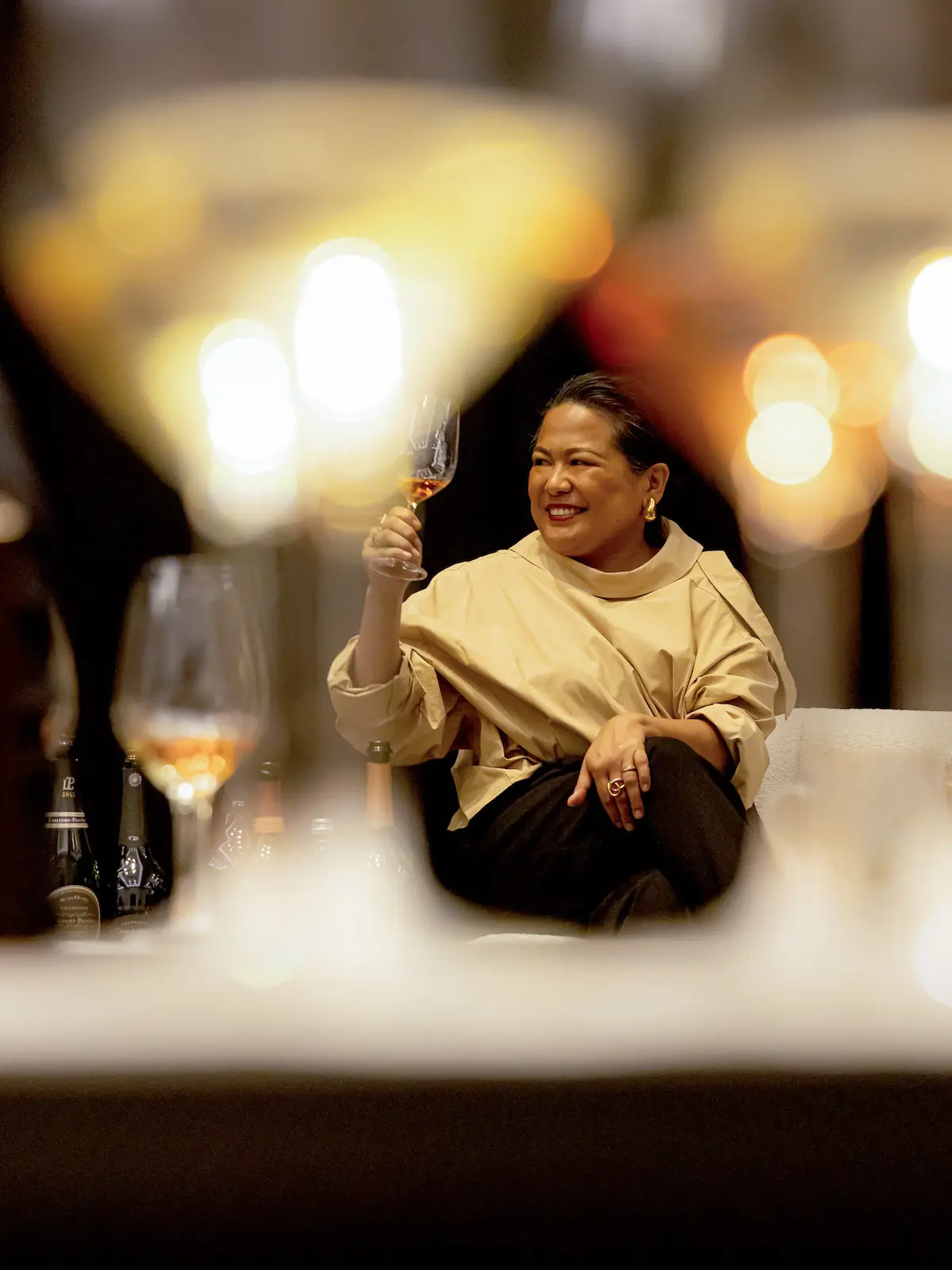
June Rodil has contributed to Houston’s hospitality scene in a profound way. Montrose Cheese & Wine, Rosie Cannonball, MARCH and The Marigold Club. All these Goodnight Hospitality restaurants are serious, fun, lively, elegant and full of great food, drinks and service. Rodil’s touches and aesthetic are everywhere in their DNA.
Born in the Philippines and raised in Texas, Rodil, who holds the title of master sommelier, is partner and CEO of Goodnight Hospitality, having joined the group in 2019. Food & Wine named her its Sommelier of the Year in 2014, and Wine Enthusiast did the same thing in 2018. Before moving to Houston, Rodil worked as vice president of operations for Austin’s McGuire Moorman Hospitality, overseeing 11 properties. She is still a partner in June’s All Day, an Austin bistro on South Congress Avenue.
I like and respect Rodil’s approach to wine, food and hospitality. She takes these three vital things seriously, but knows that the guest is the most important part of the equation. She’s someone I would gladly share a table with, because fun seriousness is an integral ingredient of life lived well.
Wine is meant to be enjoyed and savored, of course, whether you are drinking a vintage Champagne or a table wine from Languedoc, no matter the setting or occasion. Rodil lives this philosophy in grand manner. She respects the individuals who make wine, the land that produces it, and the person who happens to be drinking it at one of her tables or bar stools.
For all of her experience and study, her methods and ethos do not turn wine into something off-putting or dryly academic. “Wine is not taxidermy,” Rodil says.
Her grandfather was a fisherman in the Philippines. She grew up in a village outside of Manila, a daughter in a poor family. We hear the phrase “American success story” often. Rodil is surely writing hers daily in Montrose.
Let’s see what she has to say in this new edition of Wine Talk.
Tell us about three wines you think are drinking well at the moment. What makes them worthwhile?
June Rodil: First, I’m going to commit the cardinal sin of self promotion and say June’s Brut Rosé. I created it because I wanted a sparkling wine that felt celebratory without requiring an official occasion. It’s dry, bright, refreshing and slightly irreverent, which is also how I prefer most parties.
It’s serious enough for a proper wine glass, but not so serious that it can’t be opened on a Tuesday because everyone made it through the day.
It goes with fried chicken, lumpia, salty potato chips, oysters or absolutely nothing while standing in the kitchen deciding what dinner will be. Sparkling rosé is incredibly useful because it has acidity, bubbles and enough fruit to meet a table full of competing flavors without getting overwhelmed.
I’m also very much in a chenin blanc mood, particularly dry vouvray. Chenin can be electric and generous at the same time. It has acidity, texture and this savory, almost woolly complexity that keeps unfolding instead of announcing itself all at once. It’s one of those wines that becomes more compelling the longer it sits in the glass, although I rarely possess the restraint required to leave it there.
I’d drink the chenin with chicken adobo. The acidity works beautifully with the vinegar, while the wine has enough texture to meet the soy, garlic and richness without disappearing. Chenin is also wonderful with Vietnamese food, especially dishes with herbs, spice, fish sauce and sweet-sour tension.
And red Burgundy. I can’t help it.
I could talk about producers for hours, but that would become horrifyingly garish and make me sound like a terrible snob, so let’s talk vintages instead. Right now, I’m loving the charming vintages that let you actually enjoy the wines today, especially 2017 and 2022. They’re open, delicious and giving. Yum.
For a little more of a splurge, 2014 is hitting a really lovely stride. When you’re looking at more serious producers, 2008 and 2006 can be incredibly compelling right now. There’s maturity, but still plenty of life and structure.
Red Burgundy goes with literally anything. Any meal. There’s such an enormous range — depending on the producer, the vintage, the village, the age of the wine and whether it’s feeling open and charming or tight and brooding — that you can find a bottle for almost any table. Fish, chicken, duck, mushrooms, pork, steak, cheese, takeout, something you spent six hours cooking or something you ordered six minutes ago. Hell yeah.
JB: If cost was no consideration, tell us the one bottle you would add to your personal collection, and why.
JR: Krug Clos d’Ambonnay, 1996. My husband and I met in 1996, so the bottle would connect an extraordinary year in Champagne with the beginning of the most important partnership in my life. It’s one grape, one walled vineyard and one vintage, which is wine-geek catnip, but the reason I want it is entirely sentimental.
I wouldn’t buy it simply to possess it. Wine isn’t taxidermy. The whole point would be to open it with him, probably alongside something far less glamorous than the bottle, and celebrate everything that’s happened since 1996. (Find the wine here.)
What is your favorite grape, and why? If you don’t have a single favorite, tell me about one that you are especially passionate about.
JR: Chardonnay. That ole crazy-ass chameleon. I’m a Gemini, and people hear that and think two-faced, yotch! I prefer to think of myself as a person of multitudes (insert side-eye emoji here). So is chardonnay.
Within the span of two months, I went to see Rickshaw Billie’s Burger Patrol and Ludovico Einaudi. Those experiences couldn’t have been more different, but no one accused me of being a heretic or a hypocrite. Chardonnay is allowed to have that same range, and I love her for it. It can become Blanc de Blancs Champagne, steely Chablis, opulent Meursault, salty coastal chardonnay, something lean and mountainous, something generous and sun-drenched, something raised in steel or something wrapped in oak.
It can whisper, scream, wear sequins or sit quietly in a monastery. It can be almost anything without ceasing to be itself.
Plus, hello. It’s delicious.
JB: How about one bottle that our readers should buy now to cellar for 10 years, to celebrate a birth, anniversary, or other red-letter day?
JR: I’m going to slightly disobey the “one bottle” portion of the question and say Barolo from Lorenzo Accomasso or Comm. G.B. Burlotto. If you force me to choose one, find a bottle of Burlotto Barolo Monvigliero. I have wines from both producers in my cellar, patiently awaiting whatever day they’re eventually popped.
I don’t know exactly when that’ll be, but waiting for them makes me happy rather than anxious, which is usually a good sign that a wine belongs in the cellar.
Champagne and white Burgundy are another story. Those are extremely hard for me to wait for. I can hear them calling from downstairs. Apparently, my cellar discipline has very specific boundaries.
Nebbiolo, though, rewards patience magnificently. When it’s young, you see the architecture: acidity, tannin, perfume and structure. With age, the walls begin to come down and the wine reveals roses, dried cherries, tea, earth, spice and all kinds of beautiful, savory weirdness.
Buy at least two bottles. Write the occasion and date on them. Open one sooner than you planned, because life is unpredictable, and save the other for the full 10 years.
Where is your go-to place when you want to have a glass or bottle (outside your home and workplace)?
JR: These days, it’s often a wine club I’m part of, CdV713, with friends. We end up there for a “final round,” lose all sense of time like we’re inside a Las Vegas casino, and eventually order both Raising Cane’s and Layne’s so we can resume the very serious comparative analysis of fried chicken fingers.
Huynh Restaurant is another favorite, especially on a Monday night. It’s one of my longtime haunts. The Vietnamese food is wonderful and it’s BYOB. Since I’m currently in my chenin mood, that’s been a particularly useful combination.
That said, when I’m not drinking wine, I’m more often drinking a martini. Put me bellied up to a bar, asking what gins they have and whether they can make me a 3-to-1 martini with a twist, and I’m extremely content. Occasionally, the best way to remain excited about wine is to drink a martini.
If there was one thing you wish everyone would keep in mind when buying and drinking wine, what is it?
JR: You’re not taking a test.
You don’t need to know the producer’s elevation, soil composition or preferred method of canopy management before you’re allowed to enjoy the bottle. You don’t have to pretend to recognize an aroma. You’re also allowed to dislike an expensive wine and love an inexpensive one.
Tell the person helping you what you normally enjoy, what you don’t enjoy, what you’re eating and what you’d like to spend. Never apologize for your budget. A good sommelier should be delighted by those parameters, because hospitality begins when we remove anxiety, not when we display expertise.
The best wine isn’t necessarily the rarest, oldest or most highly rated bottle. It’s the bottle that makes the table more alive.
JB: We’ve all read the countless articles and papers devoted to the dire state of the wine world and industry, the stories of surplus fruit, ripped-out vines, younger drinkers abandoning wine, climate worries, and the role of alcohol in human health. What do you think needs to be done to improve the current state of wine? Better education? Marketing? How concerned are you about the future of the industry?
JR: Wine doesn’t have a quality problem. It has a translation problem.
For years, much of the industry confused education with initiation. We asked people to memorize labels, regions, classifications and rules before giving them a reason to care. We turned the language, rituals and cost of wine into a velvet rope, then acted surprised when younger consumers decided the party on the other side didn’t look particularly fun.
We absolutely need better education, but we don’t need more homework. We need better hospitality. We need clearer language, compelling wines by the glass, smaller pour options, more transparent pricing and more opportunities to drink good wine casually. We need restaurants and retailers that reward curiosity rather than exposing what someone doesn’t know.
We also need to be honest about alcohol. The health conversation can’t be dismissed or treated like an inconvenience created by people who don’t understand wine. Moderation should be built into how we serve, sell and discuss it, not buried in the fine print. People should be able to drink less without feeling like they’re participating less.
At the same time, wine needs to tell a fuller story. It’s farming, history, migration, labor, climate, cooking, family and culture. It isn’t simply an alcoholic luxury good with a score attached to it.
Younger drinkers haven’t abandoned pleasure, discovery or gathering around a table. They’re abandoning products and institutions that don’t speak to them, reflect them or justify their expense. Marketing alone can’t fix that. The experience has to become more welcoming, relevant and transparent.
Am I concerned? Absolutely. Vineyards, livelihoods and entire agricultural communities are at risk. Climate change is reshaping regions in real time. But I’m not fatalistic. Wine has survived for thousands of years precisely because it changes. Its future belongs to the people who can preserve what’s meaningful while letting go of the gatekeeping that never was.
Less velvet rope. More table, please.
JB: What is your wine eureka moment, the incident/taste/encounter that put you and wine on an intimate plane forever?
JR: My eureka moment wasn’t one transcendent bottle of Grand Cru Burgundy. It was realizing that wine was a language. I was born in the Philippines and raised in Texas, so I’ve spent much of my life translating between cultures, expectations, rooms and different ideas of belonging. Wine gave me another vocabulary for doing that. A bottle could communicate weather, history, migration, labor, family, geology and memory without saying a word.
Once I understood that, I was no longer simply learning facts about wine. I’d found a professional language that allowed me to connect people to places and, more importantly, to one another. That remains the part of wine I find most moving. The bottle matters, but what happens between the people sharing it matters more.
What has been the strangest moment or incident involving wine that you have experienced in your career?
JR: Many. There have been many, but one of the most surreal involved visiting Marion Ebner-Ebenauer in Austria.
She’d rented vintage 1950s John Deere tractors and somehow convinced me to drive one through wine country, despite the fact that I don’t know how to drive a manual transmission (insert your emoji for shame here). There are moments when you realize the Master Sommelier exam has left significant gaps in your professional preparation.
“Navigate an antique tractor without destroying an Austrian vineyard” wasn’t covered. I’m pleased to report that the vines, the tractor and I all survived.
Wine has taken me into extraordinary dining rooms and cellars, but it’s also put me on ancient farm equipment, in caves, on boats, in vineyards during biblical weather and at tables where I didn’t understand a word being spoken. The strangeness is part of its charm. You think you’re studying a beverage, and suddenly you’re participating in someone else’s entire way of life.
If you could journey to one destination (or region) tomorrow to explore its wines, where would you go?
JR: I feel extraordinarily lucky to say that I’ve already visited many places that once existed only on my dream list.
The next great adventure I want is actually through Japan, visiting sake breweries across different prefectures. The world of sake is incredibly deep, regional and wonderfully wild. I want to understand how the water, rice, climate, local food and individual traditions change from place to place. It’d be less of a single destination and more of a very delicious pilgrimage.
Oddly enough, I’ve also never been to the Loire, which feels like an embarrassing omission given how much I love its wines. I want to travel from east to west, beginning with sauvignon blanc and eventually reaching muscadet country. At the end, I’d like to pretend I’m a curmudgeonly old fisherman by the sea, eating oysters, throwing the empty shells back toward the ocean and drinking extremely cold muscadet. I have a very specific vision for this chapter of my life.
Your favorite wine reference in a work of literature (fiction, film, poem)?
JR: I need two.
First, the Parks and Recreation episode in which Tom is looking for a sommelier, April infiltrates a wine competition with absolutely no qualifications and Ben gets completely drunk on blueberry wine. It perfectly captures the absurdity of wine competitions, the confidence of someone who knows nothing but refuses to be intimidated, and the inevitable consequences of fruit wine. It’s fucking hilarious.
Then there’s Frasier and the Whine Club episode, in which Frasier and Niles compete to become Corkmaster of their painfully self-important wine club.
It’s a perfect satire of what happens when expertise turns into ego. I love wine enough to have dedicated my life to it, but not enough to stop laughing at people who take it too seriously, including myself.
Expertise should make us more generous. The moment it becomes a hierarchy or a performance, we’ve lost the plot.
Hail, Corkmaster.